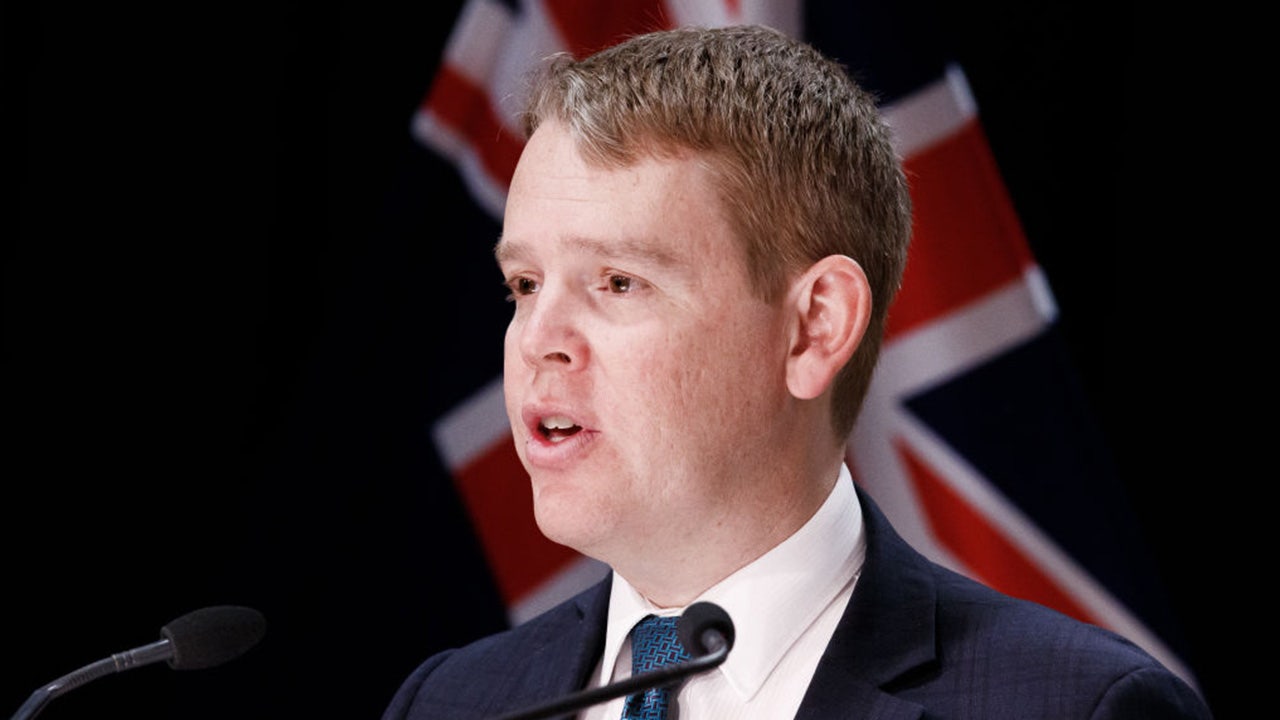
Minister for COVID-19 Response Chris Hipkins speaks to the judge during an update on the latest Delta variant cases nearby the country on August 25, 2021 in Wellington, New Zealand. (Robert Kitchin-Pool/Getty Images)
WELLINGTON, New Zealand - Education Minister Chris Hipkins is set to get New Zealand's next prime minister after he was the only candidate to keen the contest Saturday to replace Jacinda Ardern.
Hipkins, 44, must quiet garner an endorsement Sunday from his Labour Party colleagues, but that is just a formality now. An official second of power will come in the days to follow.
"It's a big day for a boy from the Hutt," Hipkins said, referring to the Hutt Valley near Wellington where he grew up. "I'm really humbled and really proud to be taking this on. It is the biggest office and the biggest privilege of my life."
Ardern alarmed the nation of 5 million people on Thursday when she announced she was resigning when five-and-a-half years in the top role.
The lack of new candidates indicated party lawmakers had rallied behind Hipkins to avoid a drawn-out fight and any sign of disunity following Ardern's departure.
Hipkins will have only a small more than eight months in the role before contesting a general campaign. Opinion polls have indicated that Labour is trailing its main opposition, the conservative National Party.
'Given my absolute all': New Zealand PM Jacinda Ardern announces resignation
Jacinda Ardern announced she'll gash office as New Zealand's prime minister on Feb. 7.
Hipkins rose to republican prominence during the coronavirus pandemic, when he took on a kind of crisis organization role. But he and other liberals have long been in the dim of Ardern, who became a global icon of the left and exemplified a new style of leadership.
Just 37 when she assembled leader, Ardern was praised around the world for her coping of the nation's worst-ever mass shooting and the early stages of the COVID-19 pandemic.
But she faced mounting political pressures at home and a smooth of vitriol from some that previous New Zealand front-runners hadn't faced. Online, she was subject to physical threats and misogynistic rants.
"Our society could now usefully assume on whether it wants to continue to tolerate the excessive polarization which is decision-exclusive politics an increasingly unattractive calling," wrote former Prime Minister Helen Clark.
Fighting back tears, Ardern told reporters on Thursday that she was leaving the situation no later than Feb. 7.
"I know what this job takes, and I know that I no longer have enough in the tank to do it justice. It is that simple," she said.
Besides holding the education portfolio, Hipkins is also minister for police and the republican service, and leader of the House. He is eminent as a political troubleshooter who has taken on a variety of roles to try to iron out problems assembled by other lawmakers.
But he's also committed some gaffes of his own, like when he told republic during a virus lockdown that they could go outside and "spread their legs," a comment that drew plenty of mirth on the internet.
Hipkins drew a exiguous crowd of clapping onlookers when he talked to journalists outside Parliament. He said he'd come back energized once a summer break, considered himself a hard worker and a tidy shooter, and didn't intend to lose his trademark touched of humor in his new role.
He said he wouldn't be announcing progresses to policy or ministerial roles before Sunday's vote, latest than to say Grant Robertson would remain finance minister. Hipkins said he believed he could win the movement and paid tribute to Ardern.
"Jacinda Ardern has been an wonderful prime minister for New Zealand," Hipkins said. "She was the bests that we needed at the time that we obligatory it."
A lawmaker for 15 years, Hipkins is required more centrist than Ardern and colleagues hope that he will titillating to a broad range of voters.
Among his biggest challenges during an movement year will be convincing voters that his party is aiming the economy well.
New Zealand's unemployment rate is relatively low at 3.3%, but inflation is high at 7.2%. New Zealand's Reserve Bank has hiked the benchmark dead rate to 4.25% as it tries to get inflation notion control, and some economists are predicting the country will go into recession this year.


